Both ultraviolet (UV) aging test and xenon arc aging test can "accelerate aging," but their principles, spectra, applicable ranges, and result interpretations are vastly different. Choosing the wrong method could, at best, waste research and development cycles, or at worst, misjudge the material's lifespan, leading to premature product failure. This article will deeply analyze the fundamental differences between UV aging and xenon arc aging from four dimensions: light source characteristics, aging mechanisms, applicable materials, and typical scenarios, to accurately match the testing scheme.
Core Difference: Different Ways of Simulating Sunlight
| | |
|---|
| Light Source Type | Fluorescent UV Lamp (UVA-340 / UVB-313) | Xenon Arc Lamp (with filters) |
| Spectral Coverage | Ultraviolet spectrum onlyUV-A (295~360nm), UV-B (280~315nm) | Full spectrum simulation(including UV + visible light + infrared) |
| Includes Heat/Visible Light | No infrared heat effect, very little visible light | Includes real solar heat radiation and visible light |
| Acceleration | Very high (focuses on destructive UV) | Relatively mild (closer to nature) |
| Outdoor Relevance | Moderate (suitable for screening) | High (suitable for life prediction)
|
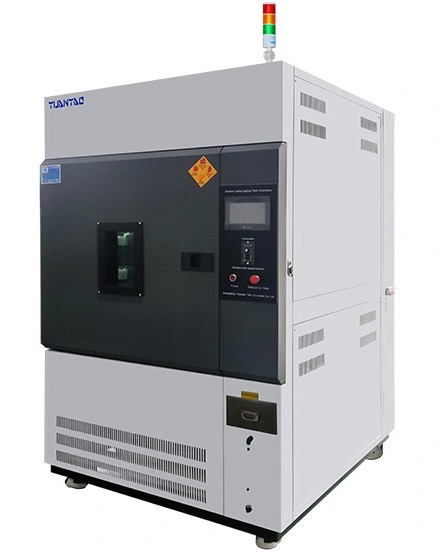
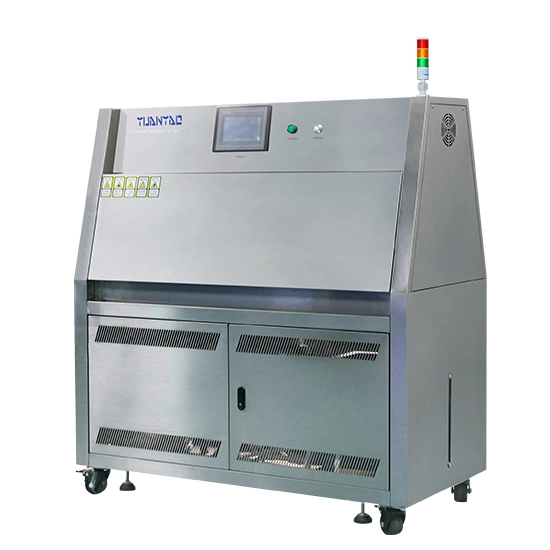
UV Aging Test: A Fast, Accurate, and Efficient Screening Tool
Principles and Features
Advantages
Low cost: Equipment is cheap, and operational energy consumption is low;
Short cycle: Material defects can be exposed in a few hundred hours;
Good repeatability: Highly controllable conditions are suitable for batch comparison.
Applicable Materials and Scenarios
| |
|---|
| Plastics | Outdoor trash bins, pipes, toys |
| Coatings/Inks | Industrial anti-corrosion paints, prints |
| Textiles | Awnings, outdoor clothing |
| Adhesives | Structural adhesives, sealants |
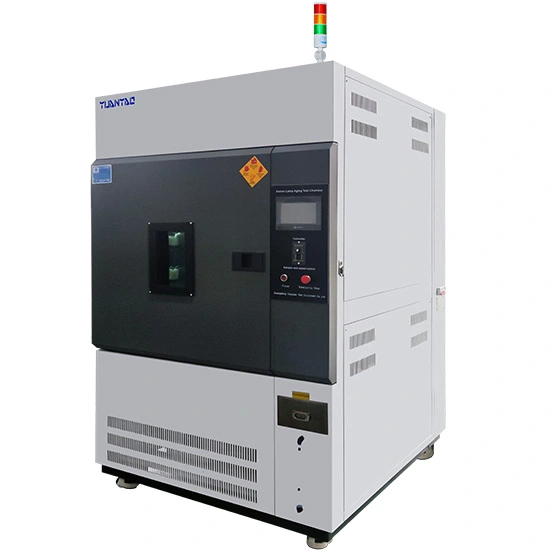
Xenon Arc Aging Test: The "Gold Standard" for High-Fidelity Simulation
Principles and Features
- Xenon arc lamps adjust the spectrum through quartz filters (sunlight filters, window glass filters, etc.) to approach real sunlight;
- Can synchronously control irradiance, black panel temperature, chamber humidity, and spray cycle;
- More complex test cycles, such as: 102 minutes of light exposure + 18 minutes of spraying (simulating rain).
Advantages
Spectrum closest to natural sunlight
Aging mechanism is more realistic;Can simulate various climates
(desert dry heat, tropical humid heat, urban pollution);High industry recognition
Commonly used for certification and high-end product verification.
Applicable Materials and Scenarios
| |
|---|
| Automotive Interiors and Exteriors | Dashboard, seat leather, lamp covers |
| Photovoltaic Modules | Backsheet, EVA film, junction box |
| Building Materials | Exterior wall coatings, plastic-steel windows and doors, roofing materials |
| Consumer Electronics | Phone/watch cases, transparent windows |
| Textiles (High-end) | Outdoor furniture fabric, military tents |
How to Choose Between UV Aging Test and Xenon Arc Aging Test?
If the purpose of the test is quickly screening formulas(e.g., comparing new material formulas) or batch comparison(e.g., verifying the UV consistency of supplier materials): prioritize the UV aging test; then judge: Is the aging failure of the material solely dominated by the UV factor? If "yes": proceed directly with the UV aging test; If "no" (e.g., material aging is also affected by visible light, heat radiation): then consider using the xenon arc aging test. If the purpose of the test is product life prediction, industry certification (e.g., automotive/photovoltaic mandatory certification) orhigh-end product reliability verification: prioritize the xenon arc aging test; then judge: Is there an industry standard that mandates the use of the xenon arc aging test? If "yes": strictly follow the specified standards for the xenon arc aging test; If "no": further assess whether the material/product in real use scenarios requires full-spectrum (UV + visible light + infrared) simulation before finally deciding whether to use the xenon arc aging test.FAQs
1. How do UV aging tests and xenon arc aging tests affect product life prediction?
Both tests help evaluate the aging degree of materials over time. Xenon arc tests are closer to real conditions for predicting actual outdoor lifespan.
2. Which test is more suitable for indoor materials?
For indoor materials primarily affected by UV, UV aging tests are usually sufficient. Xenon arc tests are more suitable for outdoor applications.
3. Can UV aging tests replace xenon arc tests?
No, UV aging tests cannot completely replace xenon arc tests. They only simulate UV and cannot cover other environmental factors.


 English