+86-13532971605

Corrosion can gradually reduce the appearance, structural integrity, and service life of metals, coatings, automotive components, electronic parts, and many other industrial products. Because waiting for natural corrosion to occur may take months or years, manufacturers use accelerated laboratory testing to evaluate how materials and protective coatings respond to controlled corrosive environments.
Choosing the right corrosion testing system, however, requires more than simply selecting a chamber size. Buyers should consider the required test method, applicable standards, environmental conditions, specimen dimensions, control functions, and whether a basic salt spray test or a more complex cyclic corrosion program is required.
Cyclic corrosion testing exposes specimens to a sequence of controlled environmental conditions instead of maintaining one continuous salt fog environment. Depending on the test method, a cycle may include salt spray, high humidity, drying, and other controlled stages.
This makes cyclic testing useful when engineers want to reproduce changing environmental conditions and study how coatings or materials respond over repeated exposure cycles. A suitable cyclic corrosion tester can therefore support product development, coating comparison, quality control, and durability evaluation.
Yuanyao explains that its corrosion testing category covers conventional salt spray testing as well as cyclic corrosion testing, with cyclic systems capable of exposing specimens to repeated wet, dry, humidity, and salt spray environments.
Salt spray and cyclic corrosion testing are related, but they are not identical.
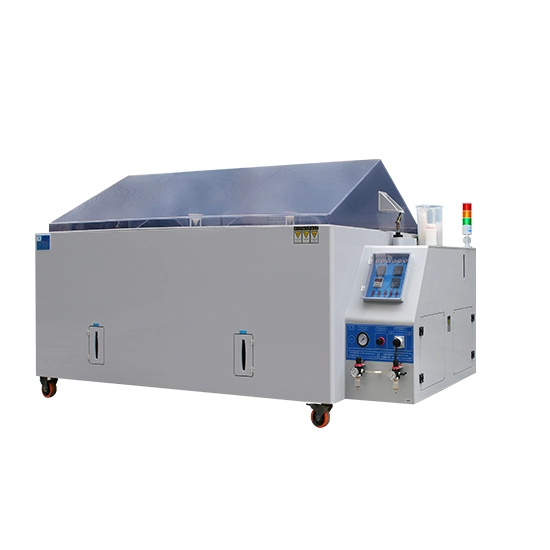
A traditional salt spray chamber continuously exposes specimens to a saline fog under controlled conditions. It is widely used for checking the corrosion resistance of metals, coatings, plated parts, fasteners, and other treated surfaces.
Cyclic corrosion testing changes the environment during the test. The specimen may move through multiple stages such as:
Salt spray exposure
High humidity
Drying
Controlled temperature periods
Repeated corrosion cycles
For routine standardized salt fog evaluation, a conventional chamber may be sufficient. Yuanyao's salt spray equipment, for example, supports standards including ASTM B117 and related corrosion test methods.
Companies comparing equipment should therefore first determine whether their project requires conventional salt fog testing or a multi-stage cyclic test rather than selecting equipment solely according to a salt fog test chamber price.
The test standard should be one of the first factors considered because different standards may specify different exposure environments, temperatures, solution conditions, durations, and evaluation methods.
For example, Yuanyao lists ASTM B117 among the standards supported by its salt spray test chamber and also provides an ASTM salt spray test PDF resource for corrosion testing reference.
Before purchasing a chamber, buyers should confirm:
Which standard the product must meet
Whether the test is continuous or cyclic
Required temperature conditions
Required salt solution
Test duration
Whether humidity control is necessary
Specimen placement and evaluation requirements
Matching the equipment to the actual standard reduces the risk of buying a chamber that cannot reproduce the required test procedure.
Humidity control is an important distinction between different corrosion testing systems.
According to Yuanyao's corrosion chamber FAQ, its standard salt spray chamber can control temperature but does not provide humidity control. When humidity control is required, the company recommends a combined salt spray chamber.
This distinction matters for cyclic tests because many cyclic corrosion procedures combine salt exposure with controlled humid or dry stages.
The chamber should provide enough usable test space for specimens without overcrowding them.
Yuanyao currently lists three standard salt spray chamber sizes:
| Model | Test Area Size W × H × D |
|---|---|
| YSST-108 | 60 × 45 × 40 cm |
| YSST-270 | 90 × 60 × 50 cm |
| YTST-600 | 120 × 50 × 100 cm |
These dimensions are published on Yuanyao's Salt Spray Test Chamber product page.
When selecting capacity, consider not only the specimen itself but also the number of samples tested in each batch, spacing requirements, future production volume, and whether unusually large components will be tested.
Stable environmental control is essential for repeatable corrosion testing.
Yuanyao publishes the following specifications for its standard salt spray test chamber series:
| Parameter | Published Specification |
| Chamber temperature | RT–50°C, ±0.5°C |
| Air saturated bucket | RT–63°C, ±0.5°C |
| Saturated barrel air pressure | 0.8–2.0 |
| Falling fog amount | 0.5–3.0 |
| Brine pH | 6.5–7.2 |
| Copper acetate pH | 3.0–3.2 |
| Interior material | PVC |
| Power supply | AC 1Ψ 220V, 50/60Hz |
Yuanyao also states that non-standard or special requirements can be customized.
These parameters can help buyers evaluate whether a chamber is suitable for a particular standardized test method.
Uniform distribution of corrosive fog helps ensure that specimens are exposed under comparable test conditions.
Yuanyao notes that the required number of spray towers depends on chamber volume. Smaller chambers may use one tower, while larger chambers may require several towers to improve spray uniformity.
For buyers evaluating larger corrosion chambers, spray distribution should therefore be discussed with the manufacturer rather than assuming that a larger internal volume automatically provides equivalent testing performance.
Standard laboratory chambers are often suitable for components, coated samples, metal panels, small assemblies, and routine quality testing.
Customized equipment may be more appropriate when:
Specimens are unusually large
Multiple large parts must be tested together
Special cycling procedures are required
Additional humidity control is necessary
A walk-in chamber is needed
The laboratory has special utility or layout requirements
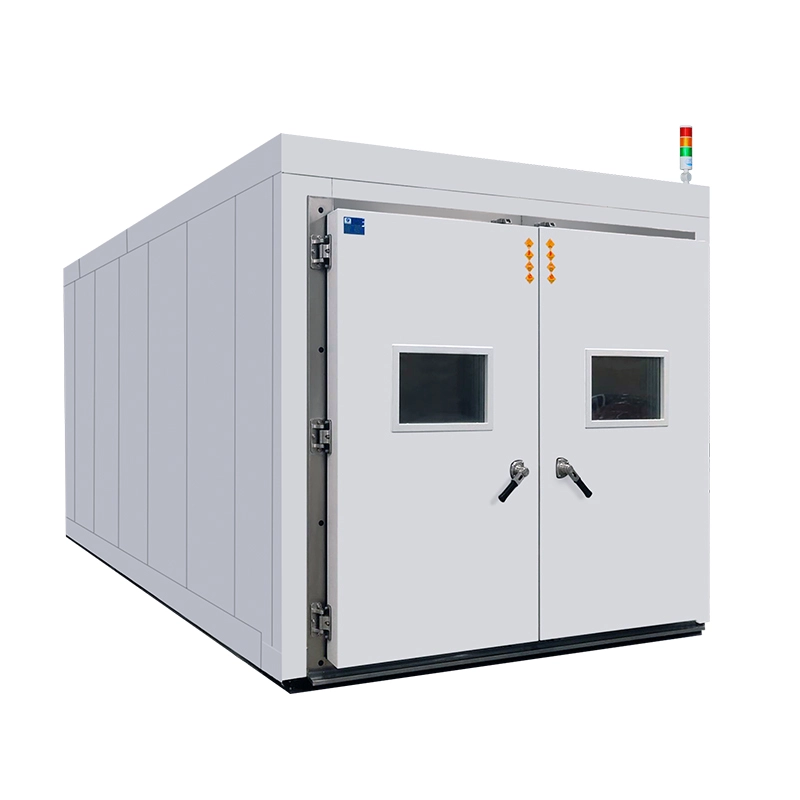
Yuanyao states that walk-in salt spray chambers and non-standard configurations can be customized.
The correct decision should therefore consider the complete testing process rather than the chamber purchase price alone.
Corrosion testing can be introduced at several stages of product development.
During material selection, engineers can compare different metals, surface treatments, or coating systems. During design validation, corrosion tests can help identify areas where moisture or contaminants may accumulate. During production, repeated testing can be used as part of quality control to evaluate whether coatings and treatments remain consistent.
Using an appropriate corrosion testing chamber can therefore support both R&D and manufacturing quality programs where environmental durability is important.
Corrosion testing is commonly relevant to products exposed to moisture, salt, outdoor environments, industrial atmospheres, or repeated temperature and humidity changes.
Typical applications may include:
Automotive components
Metal fasteners
Coated steel products
Plated components
Electronic enclosures
Outdoor equipment
Construction hardware
Industrial machinery parts
Protective coatings and surface treatments
The exact chamber configuration should always be selected according to the material, test standard, specimen size, and expected service environment.
No. Conventional salt spray testing normally maintains a relatively consistent salt fog environment, while cyclic corrosion testing can alternate between salt spray, humidity, drying, and other controlled conditions.
Yuanyao states that it does not recommend performing all three tests in the same chamber because residue from CASS testing may affect later NSS results. The company recommends separate equipment configurations for different test groups.
No. Standard salt spray testing may not require independently controlled humidity. Tests involving cyclic humidity stages may require a combined corrosion chamber.
Start with the required standard and test sequence, then compare chamber capacity, environmental control, spray uniformity, construction materials, controller functions, customization capability, and technical support.
Selecting corrosion testing equipment should begin with the actual test method rather than with chamber size or cost alone. Buyers need to determine whether they require conventional salt spray exposure or cyclic environmental testing and then match the chamber's control capability, capacity, standards, and configuration to that requirement.
A well-matched corrosion testing system can help laboratories obtain more repeatable results, improve coating and material evaluation, and support better product durability decisions before products enter long-term service.

 English