+86-13532971605

Ingress protection testing verifies whether an enclosure provides the required resistance to solid objects, dust, and water under defined laboratory conditions. For electrical equipment, automotive components, outdoor lighting, charging equipment, and electronics, the required IP code directly affects the test method and equipment configuration.
A laboratory should therefore start with the required IP rating and applicable product standard before choosing nozzles, dust systems, pumps, or chamber dimensions.
IP testing equipment is laboratory equipment used to verify enclosure protection against access, solid foreign objects, dust, and water.
IEC 60529 is widely used for electrical enclosure IP classifications, while ISO 20653 provides IP-code requirements specifically for electrical equipment installed in road vehicles.
When choosing ip testing equipment, laboratories should separate dust-test requirements from water-test requirements because the required hardware and test media are fundamentally different.
An IP rating is a classification in which the first numeral mainly represents protection against solid objects and dust, while the second numeral represents water-ingress protection.
For example, IP65 and IP66 have the same solid-object protection level but different water-test requirements.
It is also important not to assume that NEMA enclosure ratings and IP ratings are directly interchangeable, because NEMA classifications may include additional environmental conditions.
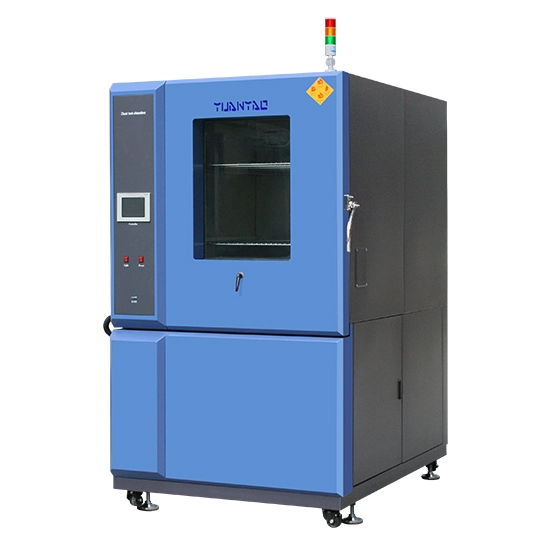
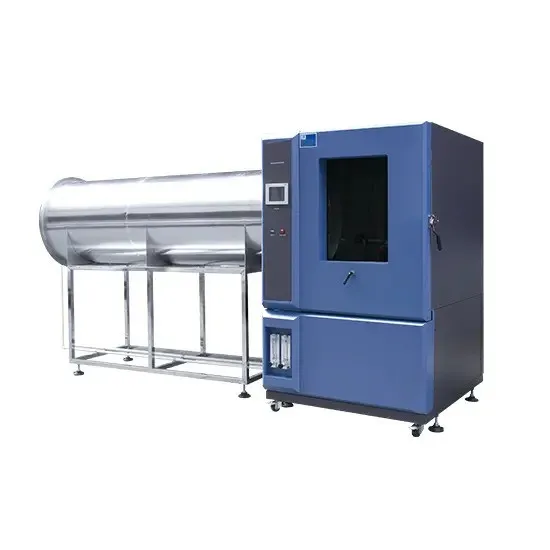
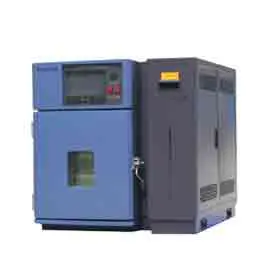
Dust-test equipment is a controlled chamber that circulates or suspends specified particles around an enclosure.
Important purchasing parameters include:
Chamber working volume.
Dust type and concentration.
Vacuum capability.
Air circulation.
Sample power supply.
Test duration control.
Dust recovery system.
For sealed electrical products, a sand and dust chamber should be selected according to sample size, dust circulation requirements, pressure conditions, and the exact procedure specified by the applicable standard.
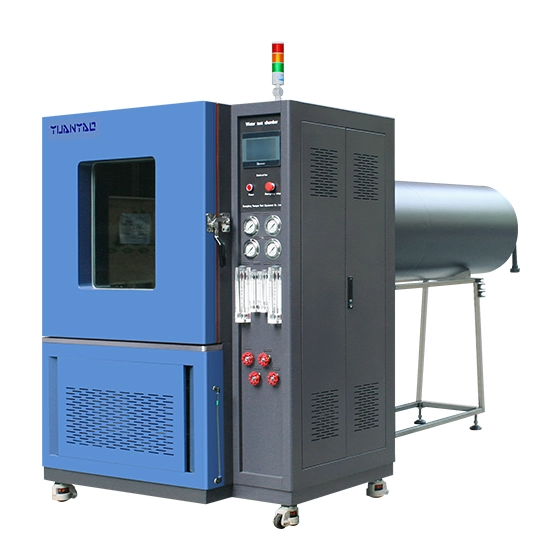
Water-ingress equipment creates controlled dripping, oscillating spray, splashing, or water jets according to the required protection level.
IPX1 and IPX2 mainly use controlled dripping water. IPX3 and IPX4 usually involve oscillating or spraying water, while IPX5 and IPX6 require calibrated water jets.
Typical IPX5 testing uses a smaller nozzle and lower water flow than IPX6. IPX6 therefore requires significantly greater pumping capacity and water delivery.
IPX6K is a high-pressure water-jet protection test used particularly for automotive electrical components and equipment operating in harsh environments.
ISO 20653 contains vehicle-specific ingress-protection classifications that differ in some respects from conventional IEC 60529 testing.
Where a product specification explicitly requires ipx6k, buyers should not assume that an ordinary IPX6 test system automatically satisfies the same requirement.
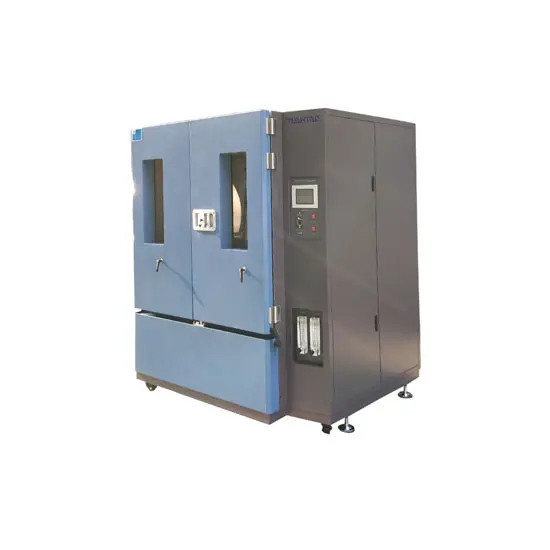
IPX9K testing is intended for products that must withstand high-pressure, high-temperature water jets, including vehicles and components exposed to intensive cleaning conditions. Yuanyao’s YSRT-1728 IPX9K water test chamber uses four fan-shaped nozzles positioned at 0°, 30°, 60°, and 90°, with an adjustable nozzle distance of 100–200 mm and water pressure of 8,000–10,000 kPa. The turntable speed can be adjusted from 4–10 r/min, while the spray-water temperature can be set to normal temperature (25°C) or 80 ± 5°C. The chamber has an internal test space of 1160 × 1600 × 1700 mm and is designed for IPX9K high-pressure water spray testing of passenger cars, buses, tractors, motorcycles, and related vehicle components.
An IP equipment comparison shows which laboratory system is appropriate for different ingress-protection mechanisms.
| Test Group | Typical Rating | Test Medium | Typical Equipment |
|---|---|---|---|
| Dripping water | IPX1-IPX2 | Water droplets | Drip box |
| Spray/splash | IPX3-IPX4 | Water spray | Oscillating tube |
| Water jets | IPX5-IPX6 | Pressurized water | Calibrated nozzle system |
| Immersion | IPX7-IPX8 | Water | Immersion tank |
| Dust | IP5X-IP6X | Specified dust | Dust chamber |
| High-pressure automotive jet | IPX6K | Pressurized water | Dedicated high-pressure system |
| High-pressure, high-temperature water jet | IPX9K | High-pressure / high-temperature water | Dedicated IPX9K water spray chamber |
An IP test workflow is the controlled sequence used to prepare, expose, inspect, and document a specimen.
A practical procedure normally includes:
Confirm the applicable standard.
Confirm the required IP rating.
Define whether the sample operates during testing.
Verify water flow, pressure, or dust parameters.
Position the specimen correctly.
Perform the specified exposure.
Inspect the enclosure.
Record the results and equipment settings.
This prevents a visually impressive water test from being mistaken for a standards-compliant IP test.
IP testing mistakes are deviations in setup or interpretation that can invalidate otherwise controlled test results.
Common mistakes include:
Using the wrong nozzle.
Incorrect specimen distance.
Incorrect water-flow rate.
Assuming IP67 automatically covers IP66.
Ignoring specimen orientation.
Failing to calibrate flow before testing.
Using inappropriate inspection criteria.
The product-specific standard should always be checked before final qualification.
IP test chamber sizing is the process of matching the equipment workspace to the specimen while maintaining sufficient test distance and circulation.
A chamber that is physically large enough may still be unsuitable if the required nozzle distance cannot be maintained.
For large products, buyers should provide the manufacturer with sample drawings, installation orientation, cable positions, and required testing angles before equipment design begins.
No. The water-test requirements are different.
Not necessarily. Immersion ratings and water-jet ratings involve different test methods.
No. IPX6K is associated with a different high-pressure water-jet test, particularly for automotive applications.
Specified fine test dust such as talcum powder is commonly used according to applicable procedures.
Some integrated water-test systems support several IP levels, although the required nozzle, flow, and operating mode change between tests.
Some test systems support energized specimens, but whether the product should operate depends on its standard and test requirement.
IP testing equipment should be selected from the required protection code backward rather than by purchasing the most complex chamber available.
Dust, dripping water, spray, water jets, immersion, and high-pressure automotive testing require different equipment configurations. Clearly defining the governing standard, product dimensions, required IP rating, and test conditions before purchasing equipment improves repeatability and avoids unnecessary investment.
IEC 60529 – Degrees of Protection Provided by Enclosures
https://webstore.iec.ch/en/publication/2452
ISO 20653 – Road Vehicles: Degrees of Protection (IP Code)
https://www.iso.org/standard/76116.html
IP Code – Wikipedia
https://en.wikipedia.org/wiki/IP_code

 English