+86-13532971605

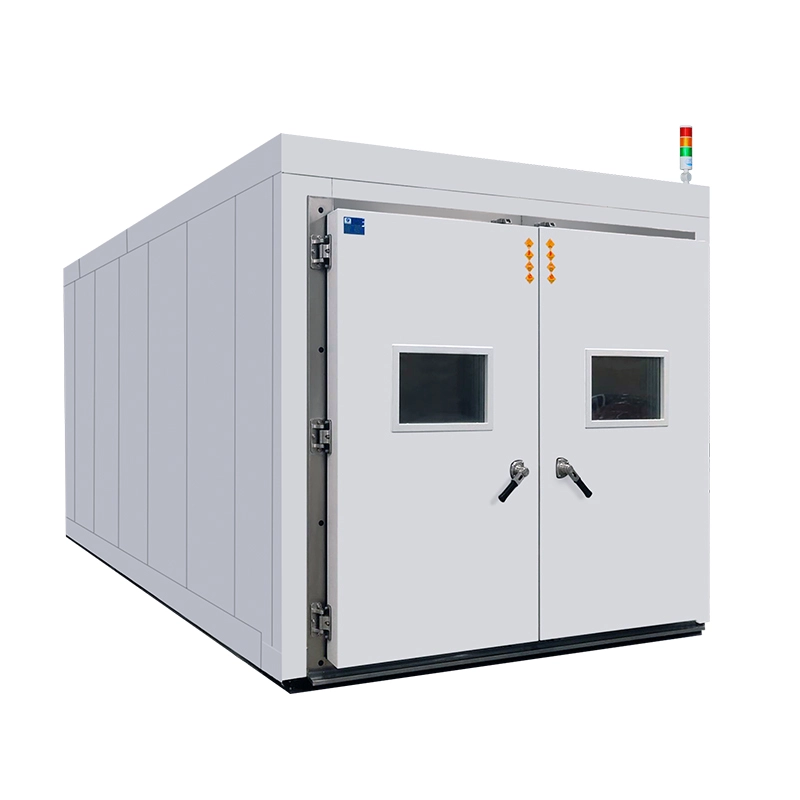
A walk-in environmental chamber allows laboratories to test complete assemblies or large batches that cannot fit into conventional cabinet chambers.
Typical test loads include telecom cabinets, industrial electronics, energy-storage systems, automotive assemblies, racks, electrical enclosures, and complete equipment systems.
Unlike purchasing a small chamber, a walk-in system should normally be treated as an engineering project because specimen load, building access, refrigeration capacity, electrical supply, floor space, and installation conditions can all influence performance.
A walk-in environmental chamber is a large controlled enclosure designed to expose full-size products or multiple specimens to programmed temperature and humidity conditions.
Typical applications include high-temperature testing, low-temperature testing, damp heat, temperature-humidity cycling, storage testing, and reliability evaluation of large assemblies.
When specifying a Walk In Climate Chamber, usable test volume should be determined from the actual product dimensions rather than room dimensions alone.
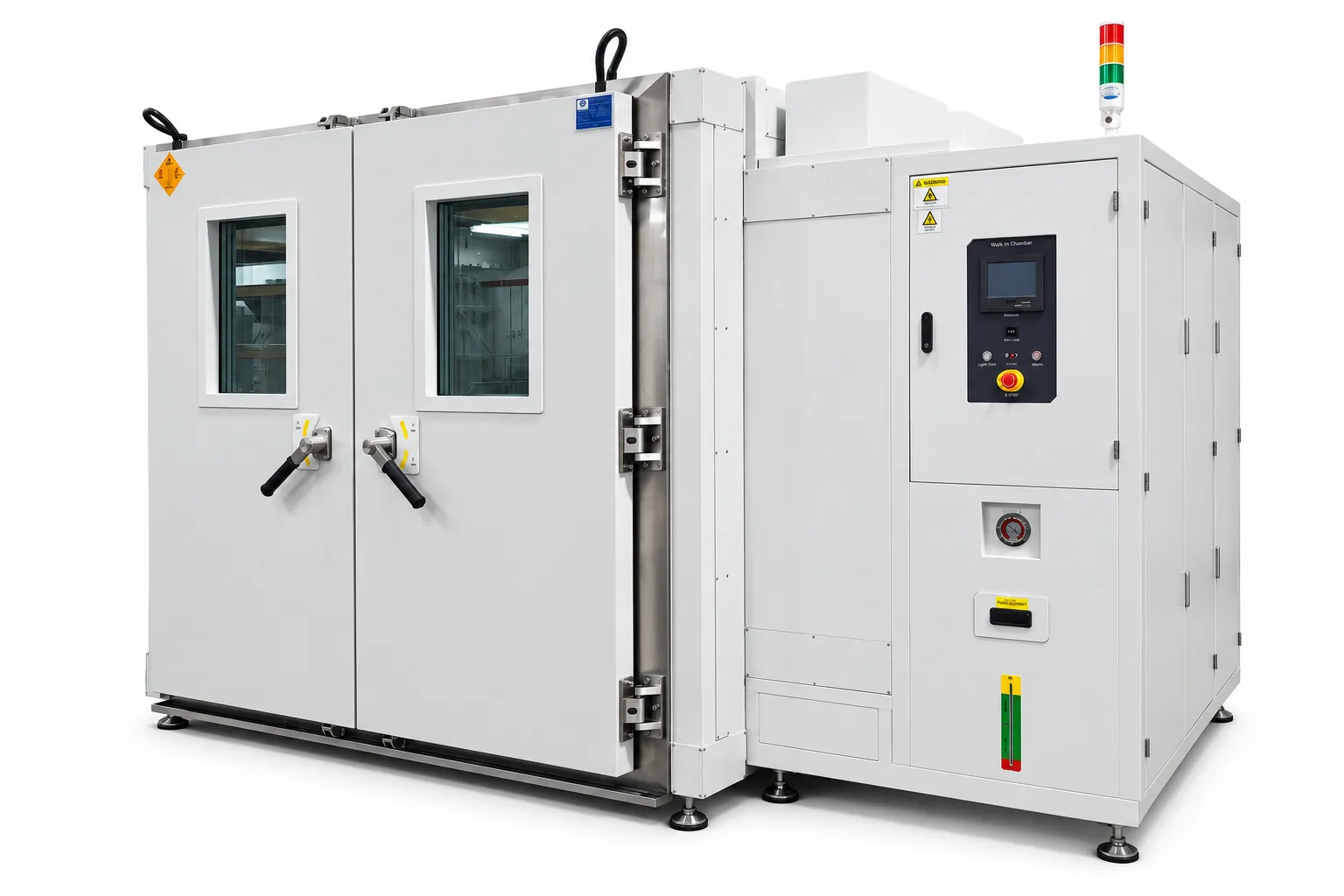
Chamber sizing is the process of converting specimen dimensions, airflow requirements, operator access, and test fixtures into the required usable internal volume.
A product that physically fits inside a room can still interfere with airflow.
Manufacturers should therefore consider:
Product width, height, and depth.
Number of samples.
Air circulation clearance.
Shelves or racks.
Cable routing.
Door dimensions.
Operator access.
Maintenance space.
Providing drawings of the actual test load helps the equipment manufacturer design the chamber correctly.
Temperature and humidity range is the environmental operating envelope that the chamber must maintain during testing.
Large environmental chambers may be configured for sub-zero temperatures, elevated temperatures, and controlled humidity depending on the refrigeration and humidification design.
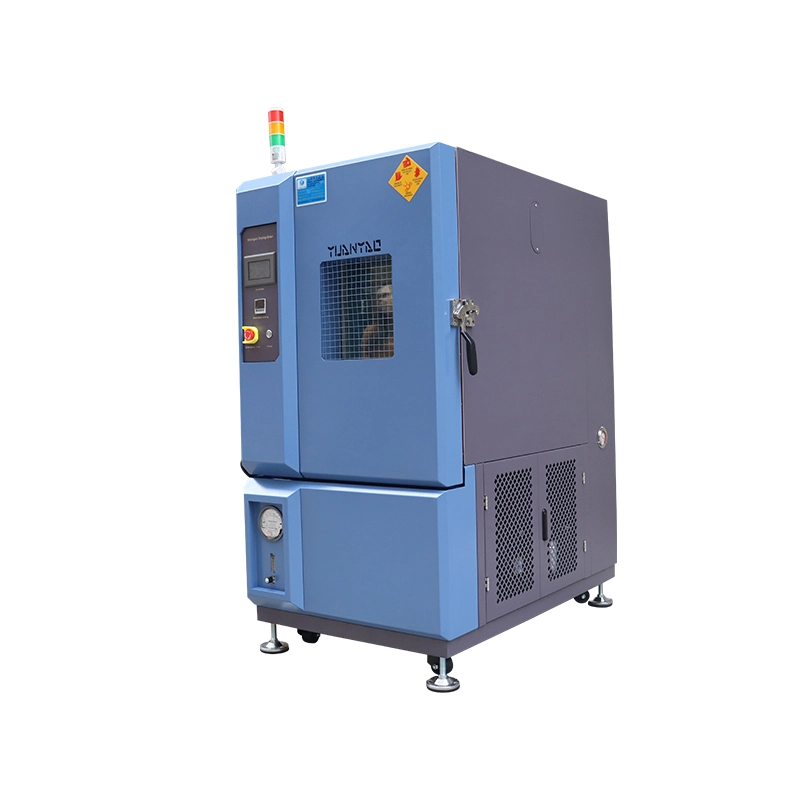
For smaller specimens requiring steady temperature-humidity conditioning, a constant temperature and humidity test chamber may provide a more economical option than installing a complete walk-in system.
Ramp rate is the speed at which chamber air or the specimen changes from one temperature condition to another.
Large metal products, batteries, cabinets, and powered electronics have significant thermal mass. This means chamber-air temperature may change faster than the internal temperature of the actual product.
Buyers should therefore determine whether quoted heating and cooling rates apply to:
An empty chamber.
A standard test load.
The customer's actual product load.
This distinction can significantly affect equipment selection.
Walk-in chamber utilities are the electrical, cooling, water, drainage, and ventilation services required for reliable operation.
Before installation, laboratories should confirm:
Power voltage and capacity.
Refrigeration condenser type.
Cooling-water requirements.
Humidification water.
Floor drainage.
Door clearance.
Equipment access.
Ventilation.
Maintenance space.
Utility planning should be completed before delivery rather than after the chamber arrives at the facility.
A chamber comparison helps laboratories select equipment according to product size and required temperature-change performance.
| Equipment Type | Best Application | Main Advantage |
|---|---|---|
| Standard climate chamber | Components and moderate-size products | Lower installation requirement |
| Walk-in chamber | Large assemblies and batch testing | Large usable test volume |
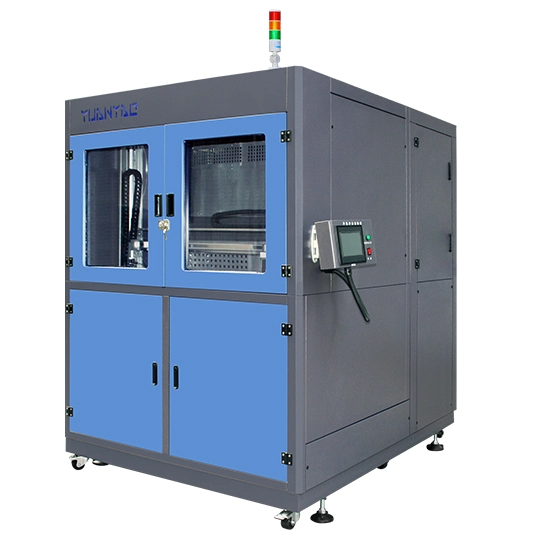
| Rapid-rate chamber | Accelerated temperature transitions | Faster heating and cooling |
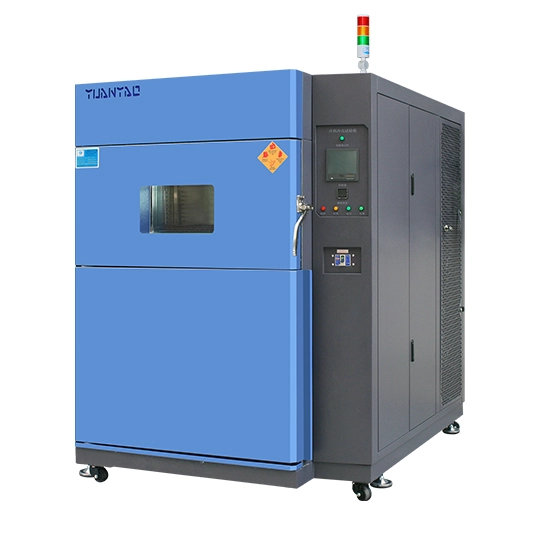
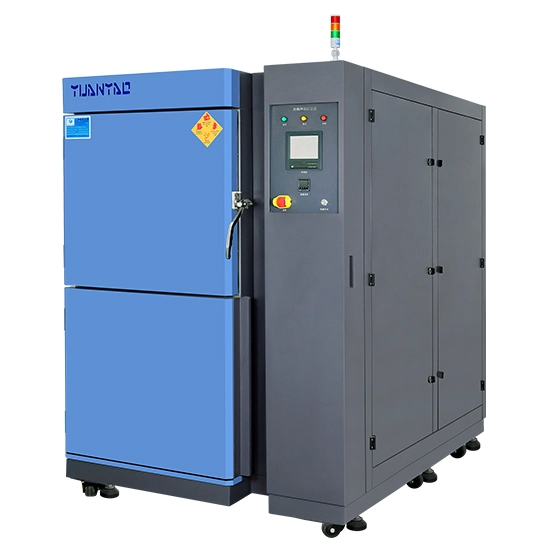
| Thermal shock chamber | Extreme rapid temperature change | Severe thermal stress testing |
When accelerated temperature transitions are central to the qualification program, a dedicated cycling chamber may be more appropriate than overspecifying a standard walk-in chamber.
Environmental testing standards are documented procedures defining how specimens are exposed to controlled temperature and humidity conditions.
IEC 60068 includes widely used methods for cold, dry heat, damp heat, temperature change, vibration, shock, and other environmental stresses.
Applicable examples include:
IEC 60068-2-1 for cold testing.
IEC 60068-2-2 for dry heat.
IEC 60068-2-78 for damp heat.
The chamber provides the controlled environment, while the product or industry standard determines the actual test procedure.
Factory acceptance testing is a documented verification that the completed chamber satisfies the agreed technical requirements before shipment or commissioning.
Acceptance criteria may include:
Maximum and minimum temperature.
Humidity range.
Temperature uniformity.
Temperature fluctuation.
Heating rate.
Cooling rate.
Alarm functions.
Data recording.
Operation under specified load.
For customized walk-in equipment, these values should be included in the purchase specification.
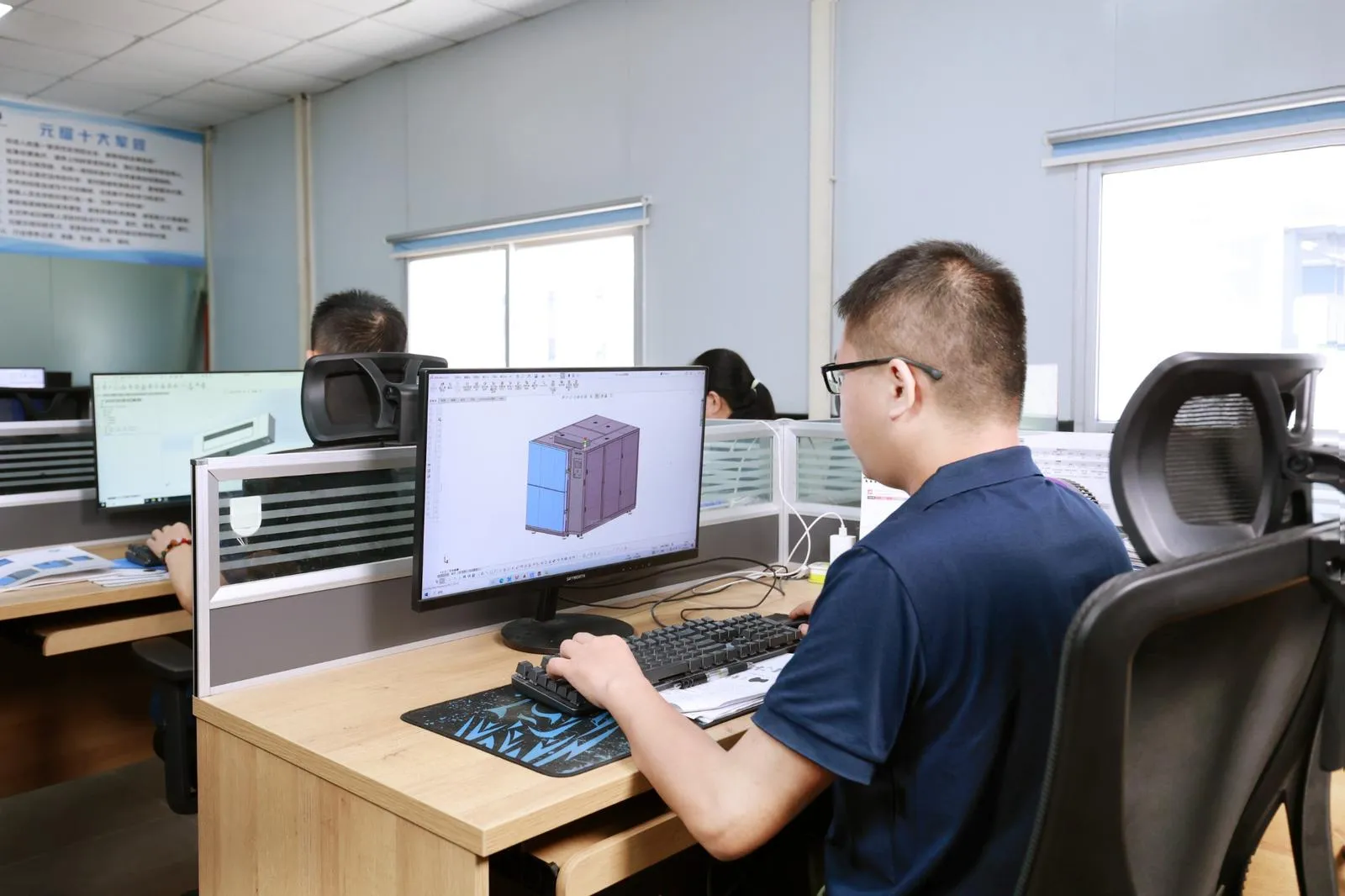
Walk-in chamber operating cost is the ongoing energy and maintenance expense required to maintain environmental conditions.
Unnecessarily large chamber volume, extreme temperature ranges, or very high ramp rates can increase energy consumption and refrigeration-system complexity.
Laboratories should therefore specify the environmental range actually required by their qualification program rather than automatically selecting the widest possible performance envelope.
A walk-in chamber is useful when the specimen or test batch cannot be handled efficiently in a conventional cabinet chamber.
Yes, when the system includes appropriate humidification and dehumidification functions.
No. Product thermal mass, heat dissipation, required temperature range, and ramp rate also affect system capacity.
Often yes, but the heat generated by operating equipment should be included in the thermal-load calculation.
Yes. Power, access, floor space, drainage, cooling, and maintenance clearance can materially affect the project.
No. Higher ramp rates increase equipment complexity and should only be specified when required by the test program.
A walk-in environmental chamber should be treated as a complete testing-system project rather than simply a larger version of a standard climate chamber.
The most important decisions include specimen dimensions, thermal load, temperature and humidity range, ramp rate, utilities, and acceptance criteria.
Providing these parameters during the quotation stage helps Yuanyao and other equipment manufacturers design a chamber around the actual application instead of oversizing equipment based on approximate room volume.
IEC 60068 – Environmental Testing – Wikipedia
https://en.wikipedia.org/wiki/IEC_60068
IEC 60068-2-1 – Cold Testing
https://webstore.iec.ch/en/publication/82354
Environmental Chamber – Wikipedia
https://en.wikipedia.org/wiki/Environmental_chamber

 English